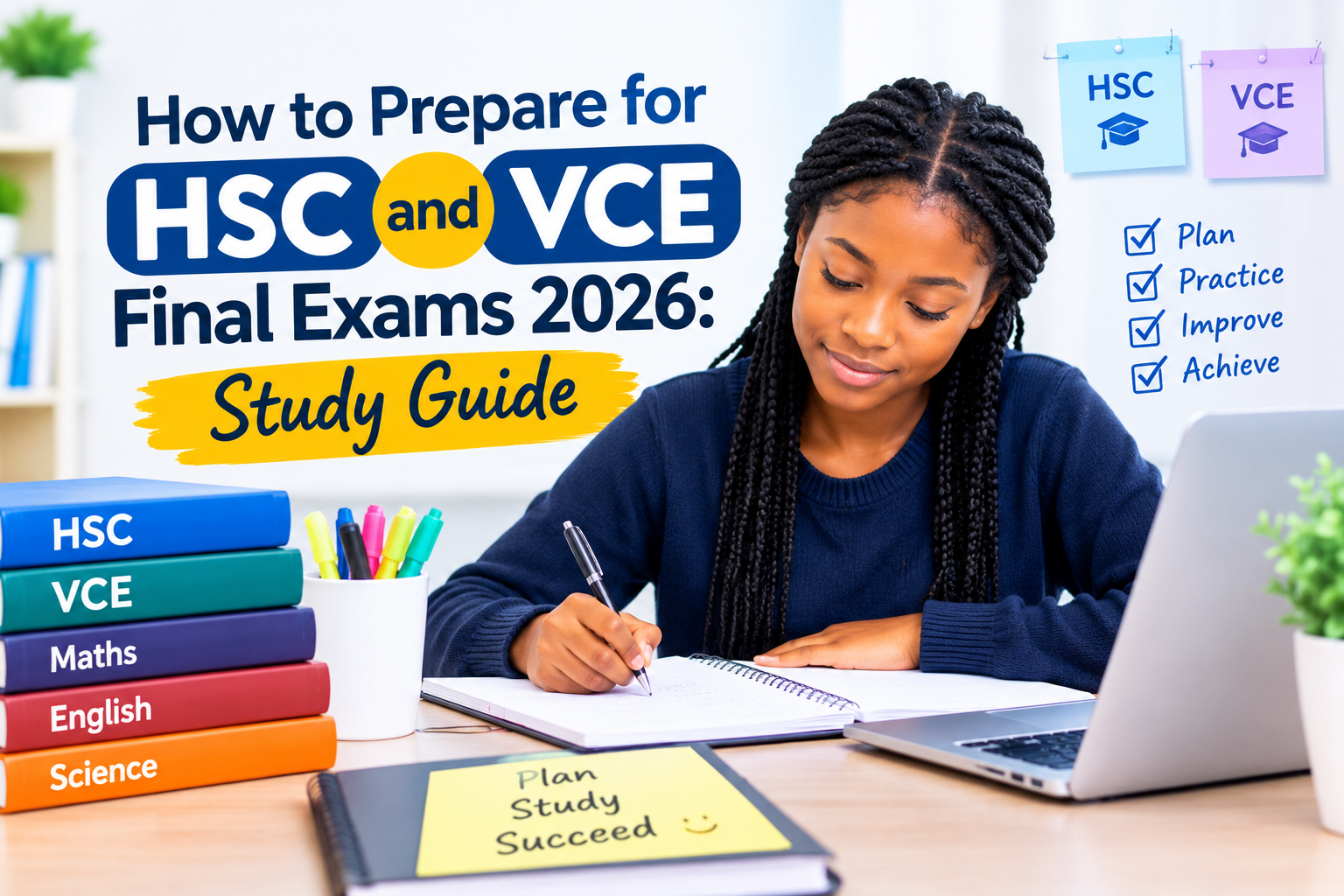

This is specifically for those preparing for the 2026 HSC or VCE final exams. if you want to learn how to build an effective study timetable, practise with past papers, understand marking guidelines and find Maths and English tutoring in Sydney and Melbourne then stick with me to the end of this article.
How to Prepare for HSC and VCE Final Exams 2026
sometimes, you may feel overwhelm while preparing for your final high school examinations especially when university admission, future career plans and years of hard work seem to depend on a few important papers. If you are sitting the 2026 Higher School Certificate (HSC) in New South Wales or the Victorian Certificate of Education (VCE) in Victoria, knowing what to study is only part of the challenge. You also need to manage your time, practise under examination conditions, understand how marks are awarded and prepare yourself to perform under pressure.
The good news is that effective exam preparation does not always require studying for ten hours every day. What matters most is how well you use the time available, identify your weaknesses and practise the skills your examinations demand.
🌍 More Available Jobs

This guide explains how to prepare for HSC and VCE final exams in 2026, where to find official past examination papers and marking guidelines, how to improve your Maths and English results, and how to choose online tutoring in Sydney and Melbourne.
🌍 More Available Jobs





Understanding the HSC and VCE Final Exams in 2026
The HSC and VCE are senior secondary qualifications that help students demonstrate their academic achievement before moving on to university, vocational education or employment. Although both qualifications involve external examinations and school-based assessments, they operate under different state systems.
The HSC is administered by the NSW Education Standards Authority (NESA), while the VCE is administered by the Victorian Curriculum and Assessment Authority (VCAA).
Understanding which system applies to you is essential because examination dates, subject requirements, assessment structures and marking resources differ.
When Are the 2026 HSC Final Exams?
According to the official NSW Government timetable, the 2026 HSC written examinations run from Tuesday, 13 October, to Thursday, 5 November. The examination period covers multiple subjects, so students should check their personalised timetable rather than assume that every subject follows the same schedule.
Students can view examination details through the official HSC written examination timetable.
When Are the 2026 VCE Final Exams?
The 2026 VCE examination period includes written, oral, performance and other external assessments. Written examinations for major subjects take place across October and November, with English scheduled for 27 October and other subjects following on subsequent dates.
Students should consult the official VCAA timetable for their specific subjects, examination sessions and any special instructions.
Important: As the 2026 examination period is already underway, students should prioritise the subjects they have not yet completed. If your examination is approaching, focus on targeted revision, timed practice and correcting mistakes instead of attempting to relearn every topic from the beginning.
How to Prepare for HSC and VCE Final Exams 2026
A good preparation strategy should help you answer three questions: What do I already understand? Which topics are costing me marks? What should I do today to improve my performance?
The following steps can help you organise your revision and make better use of your remaining preparation time.
1. Create a Realistic Revision Timetable
One of the biggest mistakes Year 12 students make is spending too much time deciding what to study and too little time actually practising.
A revision timetable gives every subject a clear place in your day and prevents you from concentrating exclusively on subjects you already enjoy.
Start by listing your remaining examinations in date order. Next, identify the topics you find most difficult in each subject. Give those topics additional attention while maintaining regular practice in subjects where you are already performing well.
For example, a student with Maths and English examinations approaching might spend the morning completing Maths questions, the afternoon analysing an English essay and the evening reviewing errors from a previous examination paper.
Your timetable should also include breaks, meals and sufficient sleep. Studying while exhausted can make it harder to concentrate, remember information and solve unfamiliar problems.
If you have several examinations within a few days, give priority to the nearest examination without completely abandoning the subjects scheduled later.
2. Identify Your Weakest Topics Before Revising
Reading an entire textbook from beginning to end may feel productive, but it is not always the best use of limited revision time.
Instead, attempt questions from each major topic and record the areas where you struggle. Your mistakes might involve misunderstanding a concept, forgetting a formula, misreading a question or running out of time.
These problems require different solutions.
If you understand a mathematical concept but repeatedly make calculation errors, additional timed practice may help. If you cannot explain the concept itself, return to your notes or ask a teacher or tutor to explain it before attempting more questions.
For English, examine whether your weaknesses involve essay structure, textual analysis, evidence, grammar or answering the exact question being asked.
This approach helps you spend more time addressing genuine weaknesses instead of repeatedly revising material you already know.
3. Practise Under Real Examination Conditions
Knowing the content is important, but being able to demonstrate that knowledge within the examination time limit is equally valuable.
Choose an appropriate past paper and attempt it without checking the answers after every question. Follow the examination duration and use only materials permitted for that subject.
When you finish, mark your work using the official marking guidelines or assessment report where available.
Record your score and the reasons you lost marks. Then revisit the questions you answered incorrectly and attempt them again after reviewing the relevant concepts.
Repeat this process with different papers so you can identify whether your performance is improving.
Timed practice is especially useful for students who understand their subjects but struggle to finish examinations. It teaches you how to allocate time, recognise question types and move on when a difficult question is taking too long.
4. Learn How Examiners Award Marks
A correct answer is important, but students must also understand what the question requires them to demonstrate.
Words such as explain, compare, analyse, evaluate and justify often require different types of responses. Simply memorising definitions will not necessarily earn the marks available for an extended response.
For Maths, show the working required by the question, use appropriate mathematical notation and check whether your final answer makes sense.
For English, develop a clear argument, support your interpretation with relevant evidence and explain how that evidence answers the question.
Official marking guidelines and assessment reports can help you understand the qualities expected in stronger responses. They are particularly useful for identifying answers that contain relevant information but do not address the question precisely.
5. Avoid Last-Minute Cramming
Trying to learn an entire subject overnight can increase stress and leave you too tired to perform well.
If your examination is close, concentrate on high-priority topics, familiarise yourself with the paper structure and review mistakes from previous practice sessions.
Use short revision sessions with specific goals. For example, complete ten questions on a weak Maths topic, revise the structure of an English essay or review the feedback from your last practice examination.
Do not sacrifice an entire night’s sleep to finish another chapter. A rested student who can think clearly is generally better prepared to apply their knowledge than one who is struggling to stay awake.
Download Past Exam Papers and Marking Guidelines
Past examination papers are among the most useful revision resources available to HSC and VCE students. They show how knowledge is tested, what types of questions appear and how you may need to structure your responses.
However, not every past paper reflects the current syllabus. Always check the subject requirements and examination specifications before relying heavily on older material.
Where to Find HSC Past Papers
The NSW Government provides access to HSC examination papers, marking guidelines and standards materials.
Students can use these resources to practise questions, assess their answers and understand the expectations for their courses.
Official resource: https://www.nsw.gov.au/education-and-training/nesa/hsc
To use the resources effectively, follow these steps:
- Select your HSC subject.
- Download a recent examination paper that matches your course.
- Download the corresponding marking guidelines.
- Attempt the questions under timed conditions.
- Compare your answers with the marking guidance.
- Write down the mistakes you need to correct before attempting another paper.
Students should pay particular attention to current syllabus requirements. The 2026 HSC is the final examination year for the existing English and Mathematics syllabuses before new syllabuses are examined from 2027, according to NESA’s 2026 timetable announcement.
This makes checking the applicable course requirements especially important when choosing older papers.
Where to Find VCE Past Exam Papers
The VCAA provides official examination papers, examination specifications, sample materials and external assessment reports.
Official resource: https://www.vcaa.vic.edu.au/assessment/vce/examination-specifications-past-examinations-and-examination-reports
Students should select their subject from the available study resources and prioritise examinations that relate to the current study design.
The external assessment reports are particularly valuable because they explain common student difficulties and provide guidance on the qualities expected in examination responses. Some reports also contain sample answers or further explanations.
For example, students preparing for VCE English can access examination materials and reports through the official English subject page:
When working with older VCE examination papers, remember that changes to study designs can affect question formats and content. Use older papers for relevant practice rather than assuming every question remains suitable.
How Many Past Papers Should You Complete?
There is no single number that guarantees a high examination score. Completing three papers carefully and learning from your mistakes may be more useful than rushing through ten papers without reviewing your performance.
If you have several days remaining, aim to complete a realistic selection of recent papers, mark them properly and revisit the topics where you lost marks.
If your examination is tomorrow, a full paper may be useful if you have enough time to review it. Otherwise, focus on selected questions from your weakest areas and revise the mistakes that are most likely to recur.
The objective is not simply to finish past papers. It is to become better at answering the questions they contain.
Top Rated Maths and English Online Tutoring in Sydney and Melbourne
Sometimes, reading textbooks and practising independently are not enough. If you repeatedly struggle with the same questions, receive disappointing assessment results or find it difficult to understand your teacher’s explanations, working with a suitable tutor may help you identify what is going wrong.
Online tutoring can be particularly convenient for Year 12 students because it allows them to access additional academic support without travelling across Sydney, Melbourne or their surrounding suburbs.
However, the best tutor is not necessarily the one with the most expensive lessons or the boldest promises. Look for someone who understands your examination system, knows the current syllabus and can explain how to improve your actual examination responses.
Online Maths Tutoring in Sydney for HSC Students
Mathematics can become challenging when several concepts depend on one another. A student who has not fully understood an earlier topic may struggle when the same concept appears in a more advanced question.
An experienced HSC Maths tutor can help you identify those gaps, practise problem-solving methods and understand how to present your working clearly.
Before choosing an online Maths tutor in Sydney, ask whether they have experience teaching your particular course, such as Mathematics Standard, Mathematics Advanced, Mathematics Extension 1 or Mathematics Extension 2.
You should also find out whether lessons include practice questions, feedback on written solutions and preparation using current HSC examination materials.
Useful places to begin your search include established tutoring organisations, independent tutors with verifiable HSC teaching experience and recommendations from your school.
When comparing providers, ask about lesson fees, availability before your examination, cancellation policies and whether the first session includes an assessment of your strengths and weaknesses.
Online Maths Tutoring in Melbourne for VCE Students
VCE Maths students may benefit from personalised support when they struggle with mathematical reasoning, complex problem-solving or applying concepts under time pressure.
The right tutor should understand the specific VCE Maths subject you are studying. General Mathematics, Mathematical Methods and Specialist Mathematics have different content and examination requirements, so a tutor who specialises in one course may not be the best choice for another.
Ask potential tutors to explain how they use VCAA examination papers, assessment reports and current study designs in their lessons.
A useful session should do more than provide the correct answer. It should help you understand the method, recognise when to apply it and avoid the mistakes that previously cost you marks.
Students in Melbourne’s suburbs can also consider fully online lessons, provided the tutor offers reliable communication, clear explanations and enough opportunities for students to work through questions themselves.
English Tutoring in Sydney and Melbourne
English examinations require more than good grammar and a strong vocabulary. Students must understand the task, organise their ideas, use evidence appropriately and develop arguments that respond directly to the question.
For HSC English students in Sydney, tutoring may help with essay planning, textual analysis, prescribed texts and writing under examination conditions.
For VCE English students in Melbourne, support may focus on the requirements of the current study design, analytical writing, argument analysis and the ability to develop clear, well-supported responses.
Before paying for lessons, ask the tutor to review one of your recent essays or practice responses. Their feedback should identify specific areas for improvement rather than simply telling you to write more or use better vocabulary.
A good tutor should also explain why a particular paragraph is weak, how to strengthen your argument and how to make your evidence relevant to the question.
Students should be cautious of anyone promising guaranteed examination scores or offering memorised essays as a shortcut to success. Examinations can use unfamiliar questions, and students need to demonstrate their own understanding.
How to Choose the Right Online Tutor Before Your Exams
If you are searching for the best HSC or VCE tutor, compare providers carefully rather than choosing the first advertisement you see.
Use the following checklist before making a decision:
- Relevant experience: Confirm that the tutor teaches your exact HSC or VCE subject.
- Current syllabus knowledge: Ask how their lessons reflect the applicable 2026 course requirements.
- Practical feedback: Look for tutors who review your answers and explain how to earn more marks.
- Flexible scheduling: Confirm that lesson times fit around your remaining examinations.
- Transparent pricing: Understand the cost of individual sessions, packages and any additional resources.
- Verifiable reviews: Read feedback from students who have used the tutor for similar subjects.
- Realistic promises: Avoid anyone who guarantees an ATAR, a particular examination score or admission to a university.
If your budget is limited, consider asking your school teacher for additional feedback, forming a small study group or using official examination resources before paying for extra lessons.
The aim is to find support that addresses a specific learning problem, not to spend money simply because examination season is stressful.
A Practical Seven-Day HSC and VCE Revision Plan
If you have approximately one week before an examination, the following plan can help you organise your remaining time. Adapt it to your subject, examination date and current level of preparation.
Day 1: Identify your weaknesses. Complete a short diagnostic exercise or selected past paper questions. Record the topics where you lose the most marks.
Day 2: Review difficult concepts. Return to your notes, textbooks or teacher feedback. Ask for help with concepts you still cannot explain.
Day 3: Practise targeted questions. Complete questions from your weakest areas and check your working carefully.
Day 4: Focus on examination technique. Practise interpreting question instructions, structuring extended responses and allocating time appropriately.
Day 5: Complete a timed paper. Simulate examination conditions and work without unnecessary interruptions.
Day 6: Analyse your mistakes. Review your answers, revisit difficult questions and practise the methods you previously got wrong.
Day 7: Consolidate and rest. Review key concepts, check examination arrangements and prepare the materials you are permitted to bring. Avoid exhausting yourself with an unrealistic final study session.
If your examination is less than a week away, combine these steps according to urgency. If you have several subjects remaining, repeat the process for each one while giving priority to your next examination.
Common HSC and VCE Exam Preparation Mistakes to Avoid
Even hardworking students can lose valuable marks because of poor preparation habits.
One common mistake is relying entirely on memorisation. Memorising definitions and formulas can be useful, but students must also understand when and how to apply them.
Another mistake is checking answers too quickly while practising. When you immediately look at the solution, you may recognise the correct method without being able to reproduce it independently.
Students also sometimes spend too much time on their strongest subjects because those sessions feel comfortable. A better strategy is to devote sufficient time to the areas where improvement is most needed.
Ignoring examination instructions is another avoidable problem. Check the official rules concerning calculators, approved materials, identification and arrival times before your examination.
Finally, do not compare your revision schedule with everyone else’s. Some students need more time to understand particular topics, while others need additional practice with timing and written communication. Your preparation should reflect your own needs.
What to Do the Night Before Your HSC or VCE Exam
The final evening should be about preparation and confidence rather than attempting to learn an entire course from scratch.
Review your summary notes, revisit a few challenging questions and make sure you know the examination location and starting time. Check the official rules for permitted equipment and other requirements.
Set out your permitted materials, organise your transport and aim to get enough sleep.
On examination day, read the questions carefully before deciding how to answer them. Pay attention to the marks allocated to each question and divide your time accordingly.
If a question seems difficult, avoid allowing it to consume the time needed for the rest of the paper. Move forward when appropriate and return to it if time permits.
Most importantly, do not assume that a difficult first question means the entire examination will go badly. Stay focused on the question in front of you and demonstrate as much of your knowledge as you can.
Frequently Asked Questions About HSC and VCE Final Exams 2026
Where can I download free HSC past papers and marking guidelines?
The official NSW Government HSC resource page provides access to examination papers, marking guidelines and standards materials. Visit https://www.nsw.gov.au/education-and-training/nesa/hsc and select the resources relevant to your subject.
Where can I download VCE past examination papers?
The VCAA publishes examination papers, specifications and external assessment reports through its official website. Visit https://www.vcaa.vic.edu.au/assessment/vce/examination-specifications-past-examinations-and-examination-reports and select your subject.
Is it too late to prepare for the 2026 HSC and VCE exams?
It depends on your examination dates and current preparation. Since the examination period is underway, students with upcoming papers should prioritise their remaining subjects, practise relevant questions and correct their most important weaknesses. Check the official timetable immediately.
Can online tutoring improve my Maths and English results?
Online tutoring can help when lessons address specific learning difficulties and include useful feedback and examination practice. Results depend on several factors, including your starting point, the quality of instruction and how consistently you apply what you learn.
Should I use old examination papers?
Yes, provided the questions remain relevant to your current course. Start with recent papers and check the applicable syllabus or study design before using older materials, especially where course requirements have changed.
Final Thoughts
Preparing for HSC and VCE final exams in 2026 requires a clear plan, consistent practice and an honest understanding of your strengths and weaknesses.
Start with the official examination timetable, identify the topics where you need the most help and use past papers alongside marking guidelines to measure your progress. If you need additional support, look for an experienced Maths or English tutor who understands your course and provides practical feedback.
You do not have to know everything perfectly to make meaningful progress. What matters is using your remaining preparation time wisely, learning from your mistakes and approaching each examination with a clear strategy.
Your final examinations are important, but panic will not improve your answers. Focus on what you can control, prepare carefully and give every remaining paper your best effort.
Use this Official sources for your Reference
-
NSW Government HSC examination resources for past papers, marking guidelines and standards materials.
NSW Government -
-
VCAA examination papers and assessment reports for current study designs, past papers and reports.
Victorian Curriculum and Assessment Authority -
Official 2026 VCE examination timetable for subject-specific examination sessions and requirements.
Victorian Curriculum and Assessment Authority