
Australia Student Visa Changes October 2026: Offshore Rules Explained
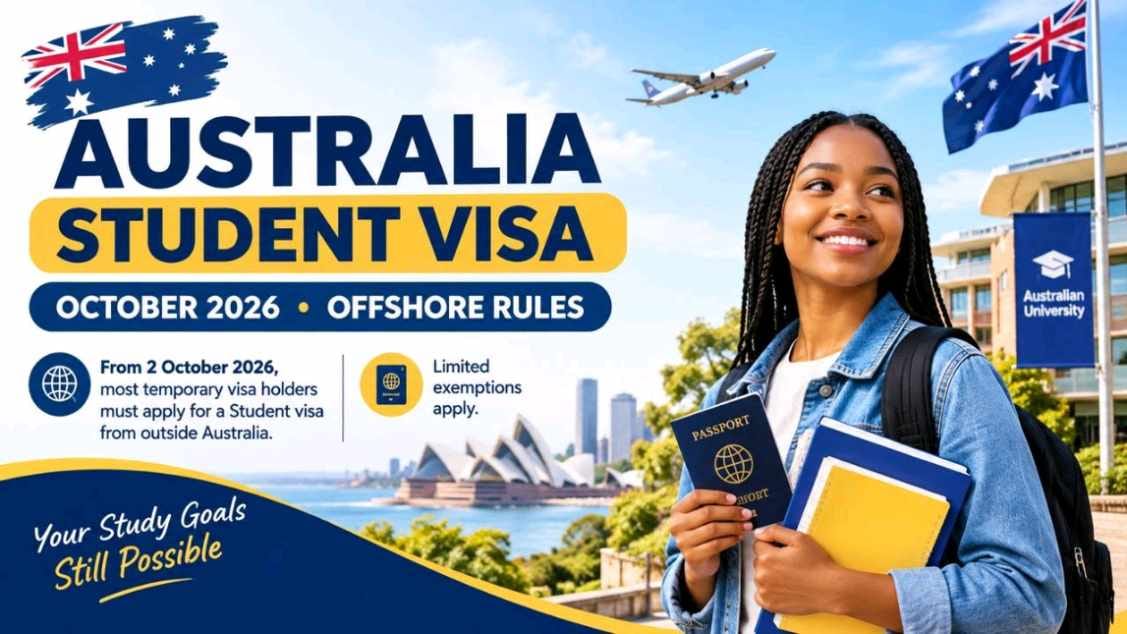
Are you an international student or intending international student? if yes, then this article is for you. Australia has introduced major changes to its international student visa application rules, and anyone planning to study in the country needs to understand what they mean before making a costly decision. From 2 October 2026, new restrictions affect who can apply for a Student visa (subclass 500) while already in Australia, as well as which applicants can include their partners and dependent children.
The good news is that Australia has not stopped accepting international students. Eligible applicants can still apply for a Student visa from outside the country, and limited exemptions remain for particular categories of students. The important thing is to establish which rules apply to your circumstances before paying tuition deposits, booking flights, or making plans to leave an existing visa.
I have put together this comprehensive guide to explains the October 2026 changes, the temporary visa categories affected by the onshore restrictions, the rules for bringing family members, and the exemptions that may help eligible research students and other applicants.
New Subclass 500 Restrictions for Temporary Visa Holders
The Student visa, officially known as the Subclass 500 visa, allows eligible international students to study an approved course in Australia. However, the government has changed the rules governing where many applicants must be when they submit their applications and when their visas are granted.
🌍 More Available Jobs

Under the rules effective from 2 October 2026, most temporary visa holders affected by the new restrictions must apply from outside Australia rather than switch directly to a Student visa while remaining in the country. The restriction can apply even when the person has already secured admission to an Australian education provider.
🌍 More Available Jobs







This is an important distinction for anyone who believes that admission to a university automatically creates a right to change immigration status. A university offer and a visa application are separate matters, and satisfying the education provider’s admission requirements does not override Australia’s immigration rules.
Why can’t I apply for an onshore student visa anymore?
Every year, new reforms, this year, the government introduced the reforms to reduce what it describes as visa hopping, strengthen student visa integrity, and keep the visa system focused on genuine temporary stays for education. Under the new arrangements, many temporary visa holders can no longer enter Australia on one visa and then apply for a Student visa from within the country.
For affected applicants, the practical consequences are significant.
First, being physically present in Australia is no longer enough. You must hold an eligible visa and meet the relevant exemption requirements before lodging a Student visa application onshore.
Second, an offer letter does not guarantee an onshore application will be accepted. Even if a university has issued a Confirmation of Enrolment (CoE), the applicant must still satisfy the immigration rules governing where the application can be lodged.
Third, leaving Australia may become necessary. If your current visa falls within a restricted category and no applicable exception allows an onshore application, you will generally need to leave Australia before lodging the Student visa application and remain outside the country until the visa is granted.
Fourth, your timing matters. Students should check their current visa conditions and expiry date before deciding when to depart. A plan to leave Australia, lodge an application, and return for classes must account for visa processing and the possibility that the new visa will not be granted before the course begins.
For example, imagine someone who entered Australia on a Visitor visa and later received an offer to study for a bachelor’s degree. Under the new restrictions, that person cannot simply assume that they can apply for a Student visa while remaining in Australia. They must check the applicable rules and, if their visa is on the restricted list, apply from outside the country.
The same principle matters to people who are already living and working in Australia under temporary work arrangements. An employment visa does not automatically create an exception to the Student visa application restrictions.
One further point is especially important: the new rules do not automatically cancel existing Student visas. If you already hold a valid Student visa, the October reforms do not, by themselves, invalidate it. However, if you want another Student visa, you must check whether the new requirements apply to your next application.
List of affected temporary visas blocked from onshore transfers
The Australian Department of Home Affairs identifies specific visa subclasses whose holders cannot lodge a Student visa application while in Australia. The restriction applies to holders of these visas in the circumstances specified by the official rules.
| Visa subclass | Visa type |
|---|---|
| Subclass 400 | Temporary Work visa |
| Subclass 403 | Temporary Work visa, Domestic Worker (Diplomatic or Consular) stream |
| Subclass 407 | Training visa |
| Subclass 408 | Temporary Activity visa |
| Subclass 417 | Working Holiday visa |
| Subclass 457 | Temporary Work visa |
| Subclass 462 | Work and Holiday visa |
| Subclass 482 | Skills in Demand or Temporary Skill Shortage visa |
| Subclass 485 | Temporary Graduate visa |
| Subclass 600 | Visitor visa |
| Subclass 601 | Electronic Travel Authority |
| Subclass 602 | Medical Treatment visa |
| Subclass 651 | eVisitor |
| Subclass 771 | Transit visa |
| Subclass 988 | Maritime Crew visa |
| Subclass 995 | Diplomatic (Temporary) visa, for primary visa holders |
Source: Australian Department of Home Affairs, Subclass 500 Student visa application rules, updated for the changes effective 2 October 2026.
If your current visa appears in this table, do not assume that an offer of admission, a change of course, or an urgent need to remain in Australia will allow you to apply onshore. The official rules state that these visa categories are precluded from onshore Student visa applications, with the applicable provisions also covering Student Guardian visa applications.
If your visa subclass is not listed, that does not automatically mean you can apply from within Australia. You still need to check whether your particular visa and circumstances meet the relevant requirements.
For students who need to apply offshore, the sensible approach is to prepare their admission documents, financial evidence, English-language evidence where required, Overseas Student Health Cover (OSHC), and other supporting documents before lodging the application. The precise requirements depend on the applicant’s circumstances and the course.
Before making a decision, consult the official Australian Student visa application rules and the Subclass 500 Student visa page. These are the appropriate starting points for checking current eligibility.
Restrictions on bringing family members and partners
For many students, studying abroad is not just an individual decision. It may involve a husband or wife, a long-term partner, or children whose education and welfare depend on the student’s plans. Australia’s October 2026 reforms have made family arrangements an important part of the visa application process.
From 2 October 2026, most Student visa applicants can no longer include their partner or dependent children in their application unless they qualify for an exemption. The restriction also applies to people applying for a further Student visa. In addition, students can no longer add family members later as subsequent entrants after their Student visa has been granted.
This means that a student who hopes to travel first and bring a spouse or child to Australia several months later should not assume that the usual family reunification route will be available under the Student visa program.
Consider a student who has received admission to an Australian university and intends to travel with a spouse and a young child. Before paying a deposit or arranging accommodation, the student should establish whether an exemption applies to the family. If it does not, the family may need to reconsider the timing of the move and explore lawful visa options suited to each person’s circumstances.
What happens to partners and dependent children?
The rules affect the inclusion of family members in a Student visa application, not simply the timing of their travel.
-
Spouses and partners: You generally cannot include your partner in a new Student visa application unless you meet an applicable exemption.
-
Dependent children: The same restriction generally applies to dependent children who would otherwise be included in the application.
-
Family members joining later: You cannot add a partner or dependent child as a subsequent entrant after the Student visa has been granted.
-
Existing family arrangements: Certain transitional provisions allow eligible applicants to include family members who were already included in an earlier visa or application. These provisions have specific conditions and are not a general exemption for every family.
The practical lesson is simple: check family eligibility before submitting the application, not after the student has received a visa. A mistake could create expensive travel changes, delayed study plans, or uncertainty about how family members can lawfully enter and remain in Australia.
Applicants should also remember that family members may have their own visa requirements. Being a spouse or dependent child does not automatically guarantee entry, permission to work, or permission to study.
Exemptions for PhD and masters by research applicants
Students considering postgraduate research need to pay particular attention to the difference between a doctoral degree and a master’s degree by research.
The Australian government’s published rules identify doctoral students as a category that may qualify for an exemption from the new restrictions on including family members. Other exemptions include eligible students sponsored by the Department of Foreign Affairs and Trade (DFAT) or the Department of Defence, eligible foreign government scholarship recipients, and eligible students who are nationals of Pacific countries or ASEAN member countries. The precise conditions must be checked against the official rules.
There is one important distinction that students should not overlook.
A PhD and a master’s by research are not interchangeable for these exemptions. The Department of Home Affairs expressly identifies doctoral degree applicants for the relevant doctoral exemptions and states that a master’s by research applicant cannot use the doctoral-degree exemption for applying onshore. A research master’s student should therefore not assume that research-based study automatically provides the same immigration privileges as a PhD.
For example, a student who has secured admission to a doctoral program may be able to include eligible family members if the student meets the relevant exemption conditions. Someone admitted to a master’s by research program must instead examine the other available exemptions and their specific circumstances.
Students relying on a scholarship should also verify whether their funding qualifies under the rules. Not every scholarship automatically qualifies as a government-sponsored exemption.
Where an exemption applies, the applicant and eligible family members must follow the relevant application requirements. The Department of Home Affairs says that, under the family inclusion exemptions, the student and accompanying family members must apply at the same time and from the same location. Applicants who do not meet an exemption should not submit family applications on the assumption that they will be accepted.
What should international students do next?
The October 2026 reforms make preparation especially important for students who are already in Australia or who intend to travel with family members.
Before taking action, work through these steps:
-
Identify your current visa subclass. If you are already in Australia, check your visa grant notice and confirm your current conditions.
-
Confirm where you must apply. Check whether your visa is on the restricted list and whether you qualify for an applicable exemption.
-
Check your course and admission documents. Make sure your proposed course is eligible and that you can provide a valid Confirmation of Enrolment when required.
-
Review your family arrangements. Determine whether your partner and children can be included before you submit your application.
-
Prepare your supporting documents. Review the financial capacity, English-language evidence, health insurance and other requirements applicable to your application.
-
Check the official rules again before lodging. Immigration requirements can change, and advice based on older rules may no longer be reliable.
If your circumstances are complicated, consider obtaining advice from a registered Australian migration agent. This is particularly important if your current visa is close to expiry, you have already lodged an application, or your family members are relying on a particular exemption.
Frequently asked questions
Can I still apply for an Australian Student visa in October 2026?
Yes. Australia continues to accept Student visa applications from eligible international students. The key change is that most applicants must apply from outside Australia unless they hold an eligible visa and meet an applicable exemption.
Can I switch from a Visitor visa to a Student visa while in Australia?
If you hold a Visitor visa (subclass 600), you cannot lodge a Student visa application while remaining in Australia under the new restrictions. You generally need to apply from outside Australia and remain outside the country until the Student visa is granted.
Does the new rule cancel my existing Student visa?
No. The reforms do not automatically cancel existing Student visas. However, if you need another Student visa, you should check the new requirements before deciding where and when to apply.
Can I take my wife or husband to Australia as an international student?
You may be able to include your partner if you meet an applicable exemption. Most Student visa applicants cannot include partners or dependent children under the rules introduced on 2 October 2026. Check your eligibility before submitting an application.
Are master’s by research students exempt from the new family restrictions?
Not automatically. Doctoral students have a specific exemption, but a master’s by research student cannot rely on the doctoral-degree exemption simply because the course involves research. Other exemptions may apply depending on the applicant’s circumstances.
Conclusion
Australia’s October 2026 Student visa reforms are a significant change for international students, particularly those hoping to switch from a temporary visa while already in the country or travel with their families.
The most important step is to establish your eligibility before making financial commitments. A university offer alone does not override visa restrictions, and an exemption available to a PhD student may not apply to someone studying for a master’s by research.
Thank you for staying with me to the end, for the most reliable and current information, consult the official Department of Home Affairs Student visa rules and its dedicated October 2026 application changes guide.
PLEASE TAKE NOTE: This article reflects the published rules available on 23 October 2026. Immigration requirements can change, so readers should confirm the rules that apply to their own circumstances before lodging an application. This guide is for general information and is not a substitute for individual migration advice.